What Is a Heavy Kettlebell Used For?
A Heavy Kettlebell is not simply a tool for making every workout harder. Used with sound technique, it can help develop strength, power, grip, and control through movements such as deadlifts, squats, carries, and swings. The load should challenge you without making your posture collapse. That distinction matters.
A 2010 American Council on Exercise-sponsored study, conducted by researchers at the University of Wisconsin–La Crosse, reported an average energy expenditure of about 13.6 calories per minute during a 20-minute kettlebell workout. The findings show that kettlebell sessions can be demanding. They do not prove that every heavy bell, exercise, or trainee will produce the same result. Pavel Tsatsouline, a well-known kettlebell coach and StrongFirst founder, sums up a useful principle: “Strength is a skill.” A heavier bell makes practice more demanding, not automatically more effective.
In practical terms, a heavy kettlebell is most useful when you can control each repetition and progress gradually. For swings, that means a firm grip, a braced trunk, and power driven by the hips—not a strained lower back. For carries, it means walking steadily while resisting the pull of the weight. Start lighter if your technique is uncertain. Heavy training can build capacity, but it also exposes weak habits. That part is easy to overlook.
What Defines a Heavy Kettlebell?
A heavy kettlebell is not defined by one universal number. It is heavy when its load challenges your strength while allowing controlled movement. For one lifter, that may be 16 kilograms; for another, 32 kilograms may feel manageable. Body size matters, but training history, grip strength, and exercise choice matter too. A weight that feels heavy for a strict press may feel ordinary for a two-handed deadlift. Context changes everything.
Look at movement quality, not ego. With a suitable heavy bell, you should brace your trunk, keep your wrist fairly straight, and finish repetitions without twisting or losing balance. The last rep may slow. It should not become a breathless scramble. For swings, momentum adds another demand, so a bell that works for deadlifts may be too heavy for crisp repetitions. Start lighter than pride suggests. Annoying, but useful. Add weight only when you can maintain the same range of motion and control across sets. If pain changes your technique, stop and reassess; fatigue can blur the line between effort and discomfort. There is no perfect threshold, and even experienced lifters sometimes misjudge a heavy day.
What Is a Heavy Kettlebell Used For?
What defines “heavy”? There is no universal cutoff. Common competition kettlebell sizes range from 8 to 32 kg; the heavier end can be used for strength-focused swings, deadlifts, squats, and carries. Choose a weight based on the exercise, your experience, and whether you can maintain good form.
The chart shows nominal kettlebell weights, not recommended training loads.
How Heavy Kettlebells Build Strength and Power
A heavy kettlebell is heavy relative to your current ability, not a fixed number.
For strength, it adds resistance to hinges, squats, carries, and controlled presses. Repeated sets challenge muscles and the nervous system to produce force. The American College of Sports Medicine recommends loads around 80% of one-repetition maximum or higher for experienced lifters prioritizing strength. Keep each rep controlled and leave enough rest to preserve technique. That distinction matters.
Power means producing force quickly, so the heaviest bell is not automatically the best choice.
For swings or cleans, choose a load you can accelerate without losing posture or timing. ACSM guidance places lower-body power training around 30–60% of one-repetition maximum, moved quickly; this is a reference, not a direct kettlebell prescription. A 2012 study in the Journal of Strength and Conditioning Research reported improved strength and explosive performance after ten weeks of kettlebell swing training in young men. The sample was small, so results are not guaranteed. It is easy to chase heavier bells; that can cost speed.
Which Exercises Use Heavy Kettlebells?
Which Exercises Use Heavy Kettlebells?
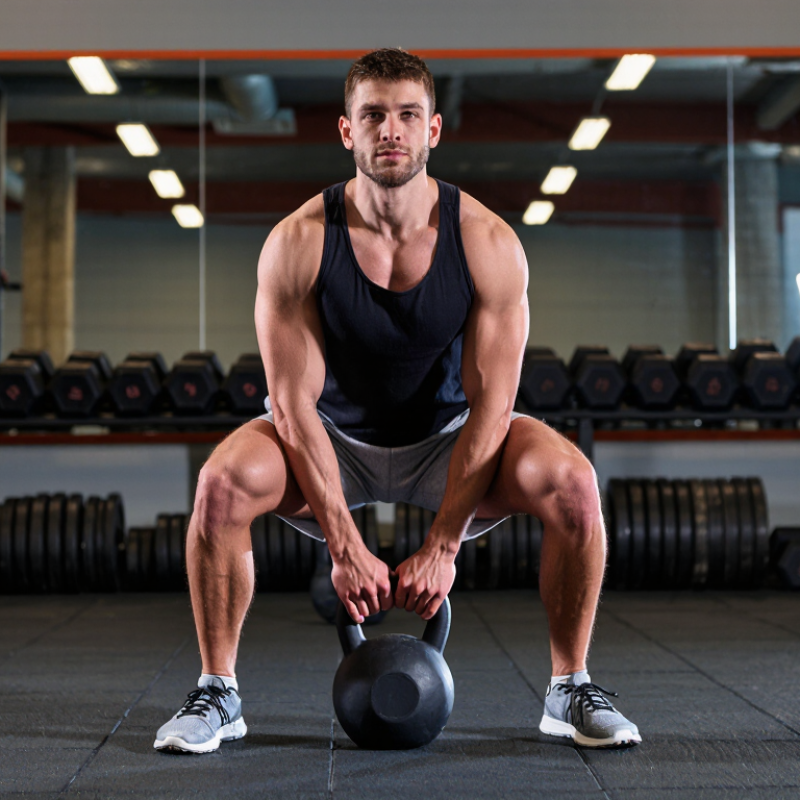
Heavy kettlebells suit exercises where you can keep control through every repetition. Kettlebell deadlifts are a practical starting point: stand over the bell, brace your middle, and push your hips back as you lift. Goblet squats can build leg strength when you stay balanced and keep your chest steady. Suitcase carries are useful, too. Hold the bell at your side and walk slowly without leaning toward it. Small details matter.
Two-hand swings can use heavier loads, but only after the hip-hinge pattern feels reliable. The power should come from your hips, not from pulling with your arms. Heavy rows may also work for experienced lifters who can keep their backs steady. A heavier bell is not automatically better; it can make technique harder to judge. I’ve found that a load that feels manageable on the first few reps may become messy near the end. That’s worth noticing.
Tips: Warm up with a lighter bell. Add weight gradually, and stop if your grip slips or your back rounds. Rest between sets. Quality beats a dramatic-looking lift.
What Is a Heavy Kettlebell Used For? - Which Exercises Use Heavy Kettlebells?
| Exercise |
Main Use |
Primary Movement |
Muscles Commonly Involved |
Heavy-Bell Consideration |
| Kettlebell deadlift |
Builds lower-body and hip-hinge strength; useful for practicing lifting mechanics. |
Hip hinge |
Glutes, hamstrings, quadriceps, back and trunk muscles |
A stable starting exercise for progressively heavier loading when the bell can be lifted with control. |
| Two-hand kettlebell swing |
Trains repeated hip-hinge power and conditioning. |
Explosive hip hinge |
Glutes, hamstrings, trunk and upper back |
Use a heavier bell only after establishing a consistent hinge and controlled swing path; the arms guide the bell rather than lifting it like a front raise. |
| Goblet squat |
Develops squat strength while the bell is held in front of the body. |
Squat |
Quadriceps, glutes and trunk muscles |
The front-loaded position can make the upper body work to stay upright. Choose a load that allows a controlled depth and posture. |
| Kettlebell clean |
Moves the bell from below the hips to the rack position; can be used to prepare for presses or squats. |
Hip drive and controlled catch |
Hips, legs, trunk, shoulder and forearm muscles |
Technique matters: guide the bell close to the body and avoid letting it flip forcefully onto the forearm. Practice with a manageable load first. |
| One-arm kettlebell row |
Builds pulling strength for the upper back and arms. |
Horizontal pull |
Lats, upper-back muscles, rear shoulder and biceps |
A heavier bell can be appropriate if the torso remains braced and the movement does not rely on twisting or jerking. |
| Farmer carry |
Challenges grip, bracing and the ability to walk while carrying a load. |
Loaded carry |
Grip, forearms, shoulders and trunk muscles |
Increase load or distance gradually. Keep steps controlled and avoid leaning to one side. |
| Suitcase carry |
Trains grip and resistance to bending sideways while walking with one bell. |
Unilateral loaded carry |
Grip, forearms, obliques and other trunk stabilizers |
Use a load that lets you walk upright without the bell pulling your torso out of position. |
| Kettlebell floor press |
Trains horizontal pushing strength with the floor limiting the range of motion. |
Horizontal push |
Chest, triceps and front shoulder |
Set up and lower the bell carefully. A heavy one-arm press requires control at the shoulder and wrist. |
|
Practical note: “Heavy” is relative to the person and exercise. Select a bell that allows sound technique, controlled repetitions and a secure grip; learn dynamic lifts with a lighter load before progressing.
|
What Training Goals Can Heavy Kettlebells Support?
A heavy kettlebell can support strength development when its load makes each repetition challenging without spoiling technique. Its offset handle demands a firm grip and a steady trunk, while squats, deadlifts, and presses train major muscle groups. The American College of Sports Medicine recommends resistance training at least twice weekly for healthy adults. A bell can help meet that goal. It is not magic.
For measurable strength gains, swings and other ballistic lifts may complement slower, controlled exercises. In a 12-week study published in the Journal of Strength and Conditioning Research, Lake and Lauder reported a 9.8% increase in deadlift strength among participants doing kettlebell training. The study was small, so that result is a useful signal, not a promise for every lifter. Heavy bells can also build muscular endurance, but repeated swings may become sloppy as fatigue rises. Stop before that point.
Power is another training goal. A crisp hip snap sends the bell forward; the arms guide it rather than lifting it alone. Heavy loads suit experienced trainees who can control the descent and keep a neutral spine. Beginners may need a lighter bell first. That feels less impressive. It is often smarter. A coach or qualified professional can help adjust load, range, and rest to individual ability.
How to Choose and Use a Heavy Kettlebell Safely
What Is a Heavy Kettlebell Used For?
How to Choose and Use a Heavy Kettlebell Safely
A heavy kettlebell can build strength through controlled deadlifts, squats, carries, and swings. Choose a weight that lets you keep your feet planted and your back steady. For swings, learn the hip hinge with a lighter bell first; the movement should come from your hips, not a hard pull with your arms. A heavier bell is not automatically better. Technique can slip quickly.
The American College of Sports Medicine’s 2009 resistance-training guidance recommends increasing loads by 2–10% when a person can exceed the target by one or two repetitions. Kettlebell weight jumps may exceed that range, so progress through cleaner repetitions or extra sets before moving up. Try a few controlled repetitions, then stop if your grip opens, your posture changes, or the bell pulls you off balance. There is no perfect test. The right choice can feel almost too easy at first.
Tips: Clear the floor and check the handle for moisture. Keep the bell close during deadlifts, and set it down rather than twisting under load. Rest between sets. If pain feels sharp or unusual, stop and reassess your form or ask a qualified trainer.